BREAKING NEWS: Firecell and Accelleran Merge to Deliver Sovereignty-Compliant Industrial Private 5G Learn more

BREAKING NEWS: Firecell and Accelleran Merge to Deliver Sovereignty-Compliant Industrial Private 5G Learn more
Home > 5G or Wi-Fi 6?

5G or Wi-Fi 6?

The world of enterprise wireless connectivity is changing fast, 5G and Wi-Fi 6 are part of the new generation of Internet access technologies. With each their advantages, how are they different and what can we expect from their use?

The world of enterprise wireless connectivity is changing fast, 5G and Wi-Fi 6 are part of the new generation of Internet access technologies. Capitalizing on Their Unique Strengths, how are they different and what can we expect from their use?

Wi-Fi is the most popular way to access the internet worldwide. Over the years it has evolved from what we now refer to as Wi-Fi 4 all the way to Wi-Fi 7, which was released in January 2024. The theoretical data rates have increased significantly in the meantime and are expected to increase even further going forward as Wi-Fi 7 becomes more prevalent.

4G/LTE had limited deployments within enterprises. This was mainly due to the fact that the technology hadn’t matured enough to be deployed easily and seamlessly across the enterprises. Presently dedicated spectrum can guarantee quality of service that wasn’t as easily available previously.. This makes it easier for 5G deployments across enterprises without worrying about the legacy mobile technologies or public mobile networks.

Wi-Fi on the other hand has to co-exist not just with legacy Wi-Fi but also with other technologies that can use the legacy ISM band or the unlicensed 5/6 GHz band. It is possible that the 5/6 GHz band is empty today and can be used to deliver stellar results but it’s getting congested fast with newer access points and devices having these bands inbuilt and available to use by default.

While Wi-Fi 6 is commonly deployed across enterprise networks, 5G is increasingly gaining ground for providing connectivity for important use cases. Nevertheless, they both have a role to play and complement each other nicely for variety of use cases.

Wi-Fi and 5G are complementary

While Wi-Fi and 5G seem to be competing wireless technologies, they are indeed distinct protocols for wireless local area communication. However, Wi-Fi 6 and 5G complement one another rather than compete against one another. Here’s how:
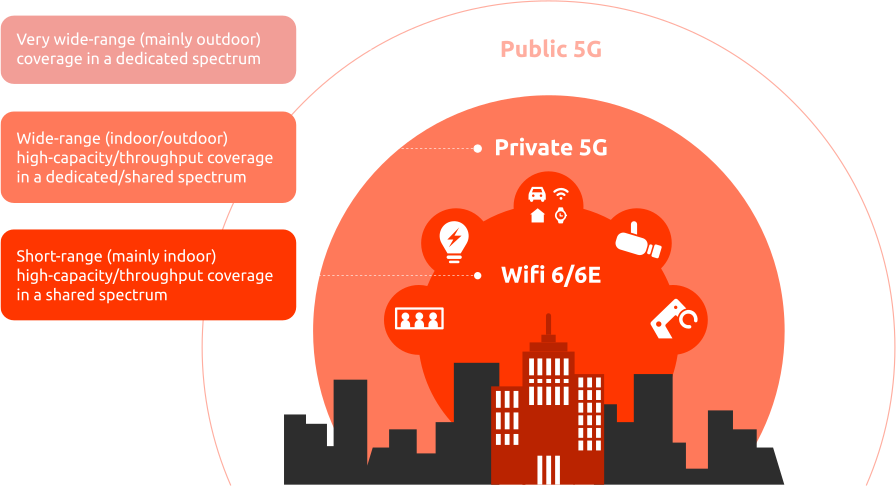
Wi-Fi 6:

  • Is a very cost-effective technology to provide coverage indoors.
  • Is ideal for most indoor environments like homes, enterprises, and other public spaces. It generally provides reliable, cost-effective connectivity for a large number of devices.
  • Uses unlicensed spectrum hence it has a shorter range but is well-suited for localized coverage.
  • Deploying Wi-Fi is easier with Wi-Fi competence easily available within enterprise IT departments.

On the other hand, 5G

  • Is designed to be deployed in licensed spectrum which provides an advantage of having a much larger range (depending on the radio power) and at the same time avoid interference from other unknown and unexpected sources.
  • Is engineered to meet quality of service (QoS) requirements for a significantly wider variety of use cases compared to Wi-Fi.
  • Supports both wide-area and local coverage with full mobility. It has in-built handover and mobility management that allows for seamless movement within the coverage zone even if the devices operate across the radios/access points.
  • Offers low latency and high-throughput making it an ideal choice for wide variety of enterprises making use of Autonomous Guided Vehicles (AGVs) and Autonomous Mobile Robots (AMRs).

In an enterprise setting with both 5G and Wi-Fi 6, different use cases are better served by each technology due to their distinct characteristics and strengths:

  • Better Served by Enterprise Wi-Fi:
    • General Office Connectivity: Wi-Fi is typically more cost-effective and easier to deploy for standard office tasks such as internet browsing, email, and collaboration tools.
    • BYOD (Bring Your Own Device): Wi-Fi is more suited for environments in which employees bring and connect their own devices, including laptops, smartphones, and tablets.
    • Indoor Coverage: In smaller indoor spaces, Wi-Fi can provide strong and reliable coverage without the need for extensive infrastructure.
    • High Bandwidth Applications: Wi-Fi is often ideal for high-bandwidth activities such as video conferencing, streaming, and large file downloads within a limited area.
    • Temporary Setups: For short-term events or rapidly changing environments, Wi-Fi offers quick and flexible deployment without significant investment in infrastructure.
  • Better Served by 5G Private Networks:
    • Industrial IoT (IIoT) Applications: 5G provide superior reliability and low latency for critical IIoT applications such as automation, remote monitoring, and control of machinery.
    • High Mobility Use Cases: Environments with high mobility requirements, such as ports, logistics centers, and large warehouses, benefit from the seamless connectivity provided by 5G.
    • High Security and Privacy Requirements: 5G offers enhanced security and data privacy, making them suitable for industries with stringent regulatory requirements, such as healthcare, finance, and defense.
    • Wide Area Coverage: 5G can cover larger areas and provide better service continuity in environments like campuses, large industrial sites, and remote locations.
    • Critical Communications: Applications requiring ultra-reliable low-latency communications (URLLC), such as real-time control systems, autonomous vehicles, and mission-critical communications, are better served by 5G.
    • Quality of Service (QoS) Management: 5G provide advanced QoS capabilities, ensuring consistent performance for critical applications and services.

It makes sense for enterprises and industries to deploy both 5G and Wi-Fi to optimize their network infrastructure to meet the specific needs of different use cases, ensuring robust, reliable, and secure connectivity across their operations.

5G is better suited for industrial use cases

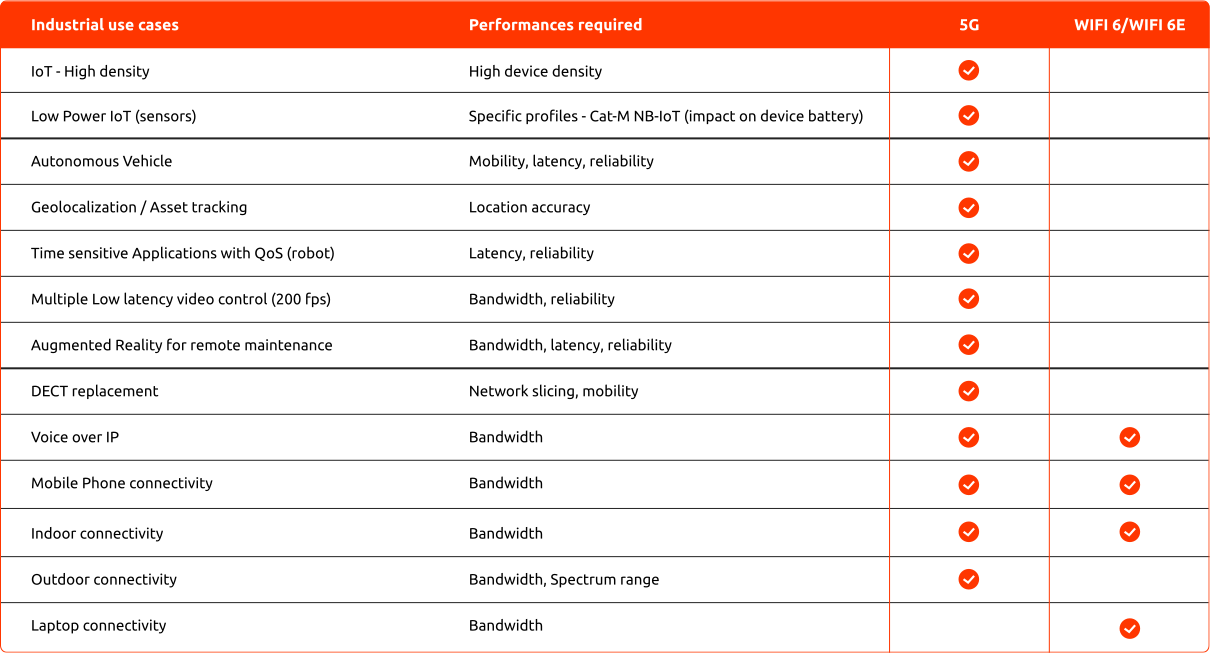
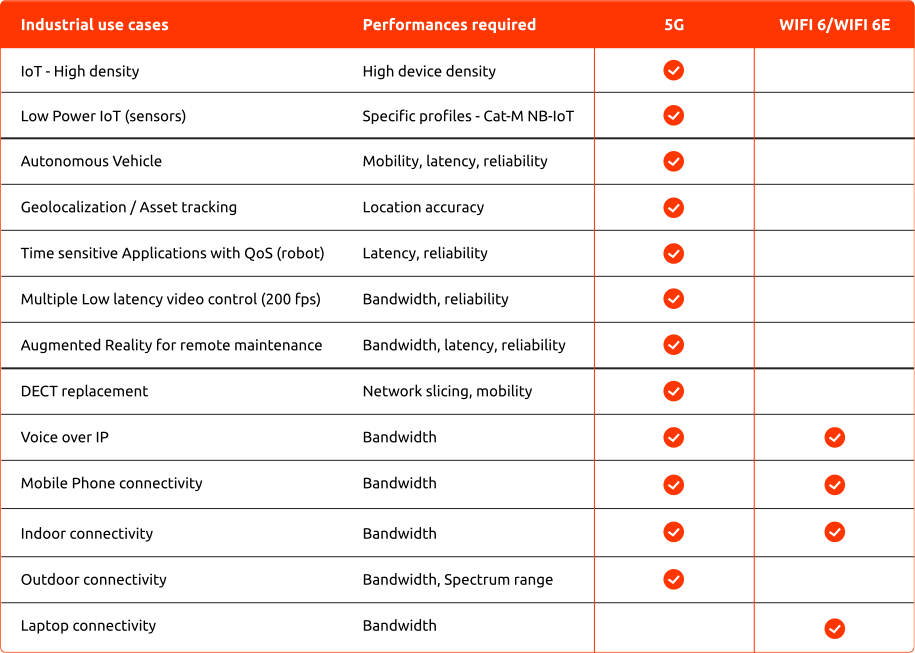
The majority of industrial applications require a certain level of performance that can be very challenging to achieve with current Wi-Fi standards. Here’s how 5G compares to Wi-Fi for industrial use cases:

Based on the table, we can summarize the advantages of 5G over Wi-Fi as follows:

  • Latency and Data Rates: 5G guarantees low latencies that are critical for real-time applications in industrial settings, such as robotics, machine control, AGVs, and AMRs. 5G is also able to guarantee much higher data rates that are beneficial for applications requiring high-speed data transfer, such as real-time video monitoring and advanced analytics. 
  • Reliability and Resiliency: 5G offers various levels of security including authentication mechanisms, ciphering of data, and integrity protection of messages that ensures sensitive data from enterprises and industries cannot be snooped upon or tampered with. The redundancy features in the 5G architecture ensure high reliability, which is important for mission-critical industrial applications where downtime can lead to significant financial losses or safety hazards. 
  • Scalability and High Capacity: Depending on the available bandwidth, 5G can support a huge number of connected devices per square kilometer, which is generally essential for industrial IoT environments wherein numerous sensors, actuators, and devices need to communicate simultaneously. 5G also allows increasing the coverage area by adding properly planned radios that can allow for seamless mobility of the devices. In addition, network slicing allows creation of multiple virtual networks on a single physical infrastructure, each tailored to specific application requirements. This capability plays a vital role to ensure that critical industrial applications can have dedicated, high-priority network resources without interference from less critical applications and other employee communications networks.
  • Edge Compute and Storage: 5G networks are designed to integrate with edge computing infrastructure, bringing computational power closer to the source of data generation. This is crucial for latency-sensitive applications such as predictive maintenance, real-time quality control, and augmented reality (AR) for maintenance and training. In addition, storage of data locally ensures that information is available at  very short notice, as well as sensitive information  remaining secure on the premises. 
  • Reduced Interference and Improved Quality of Experience: Industrial environments often have significant electromagnetic interference (EMI) from machinery and equipment. 5G allows the use of licensed bands in various different spectrum (including millimeter waves) and advanced interference management techniques make it more robust in such challenging conditions compared to Wi-Fi 6, which primarily operates in the 5 GHz bands. The ability to provide guaranteed quality of service (QoS) for different types of traffic ensures that critical industrial applications receive the necessary bandwidth and low latency, without being impacted by other less critical traffic, thereby improving the end-user quality of experience (QoE).

It should be kept in mind that it is not 5G or Wi-Fi, but 5G and Wi-Fi, with Wi-Fi complementing many aspects of improving connectivity within the enterprise. The most obvious case is the segmentation of traffic to offload non-critical or less latency-sensitive traffic (e.g., employee devices, monitoring systems, and routine data transfer) to Wi-Fi 6 thereby helping optimize the use of 5G bandwidth and reduce congestion.

A comparative performance analysis

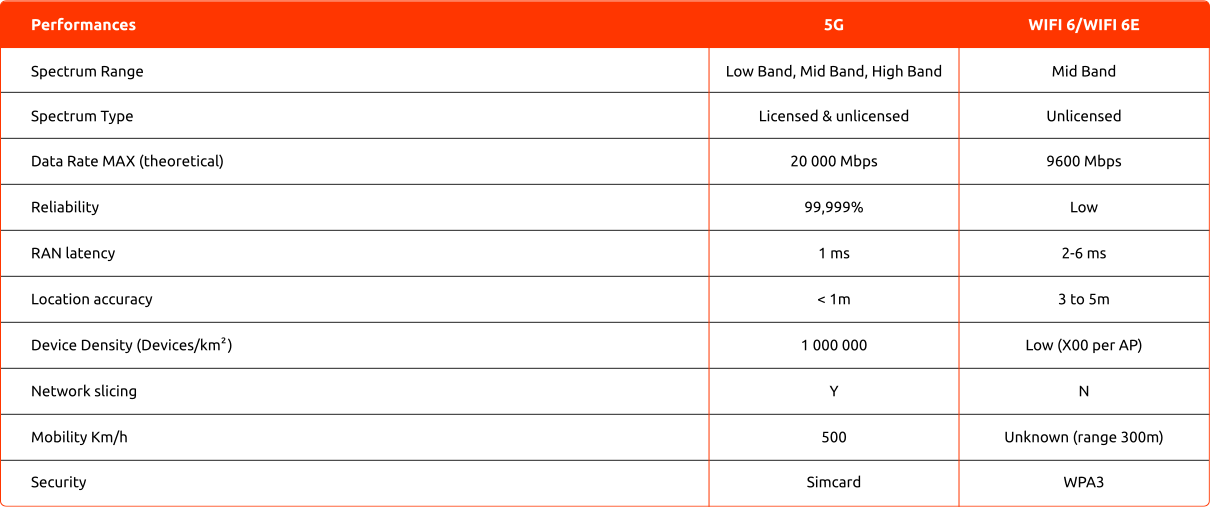
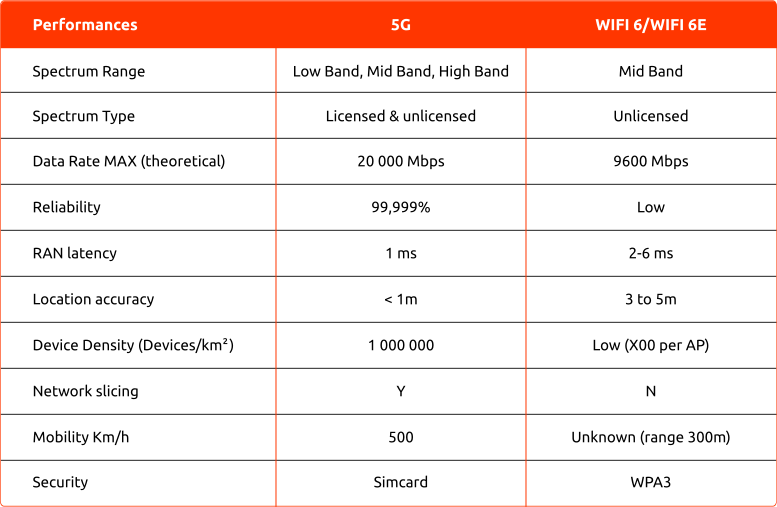
To better understand how 5G and Wi-Fi compare, here’s a performance analysis using KPIs crucial for an optimized enterprise connectivity:

More about each KPI

Better range (factor of 10 to 20), meaning that for the same coverage you need 10 times less access points.

Licensed = the spectrum is reserved for you, so that you have a guaranteed QoS and no interference with other services.

The theoretical difference is minor.

You can guarantee the bandwidth and the latency for a specific service with 5G, while you are in best effort with LAN.

5G latency is validated, while LAN latency is purely theoretical.

The gap has a direct impact on the use case supported (i.e. indoor geo-fencing cannot be supported by LAN.

The gap prevents LAN to support massive IOT use cases in a factory.

Allows to guarantee a bandwidth for critical services, it increases the QoS and to propose different QoS per service in a single Private 5G network.

AGV use case is not well supported by LAN as AVGs have to stop and maintain long security distances when they switch from one access point to another.

The sim card guarantees a much higher level of security.

Conclusion

Both 5G and Wi-Fi 6 offer significant advantages and excel in different areas. While many enterprise’s requirements are already satisfied with existing Wi-Fi 6 solutions, many others require a much more reliable and capable enterprise 5G network. This is the main reason for an increased interest in private 5G solutions. It is important to remember that 5G and Wi-Fi 6 can create a complementary and robust connectivity solution, leveraging the strengths of each technology to meet diverse operational needs and optimize performance, cost, and complexity.

Breaking news
Firecell and Accelleran Merge to Deliver Sovereignty-Compliant Industrial Private 5G
Want to become a Partner?
Calculate your TCO